
Many businesses spend time, money, and energy trying to generate more leads. They invest in websites, ads, social media, referrals, networking, content, and marketing campaigns. But once the leads start coming in, another problem appears: the business does not have a clear system to manage them.
A lead might come through a website form. Another might send a Facebook message. Someone else may call, email, or ask for a quote through a landing page. At first, this feels exciting because enquiries are coming in. But without a proper system, those opportunities can quickly become scattered, forgotten, or followed up too late.
This is where many businesses lose money without realising it. The issue is not always that they need more leads. Sometimes, the bigger issue is that they are not properly managing the leads they already have. A missed call, delayed response, forgotten follow-up, or lost email can be the difference between winning a customer and losing them to a competitor.
A CRM, or Customer Relationship Management system, helps solve this problem by keeping leads, contacts, conversations, tasks, appointments, and sales opportunities in one organised place. Instead of relying on memory, spreadsheets, inboxes, or sticky notes, a CRM gives your business a central system for tracking every enquiry from first contact to conversion.
At 2in1 Digital, we help businesses use CRM automation, AI workflows, and virtual assistant support to create smoother lead management systems. The goal is simple: help businesses stop losing leads, respond faster, follow up consistently, and turn more enquiries into booked appointments.
What Is a CRM and Why Does It Matter?
A CRM is a system that helps businesses manage relationships with leads, prospects, and customers. It stores important information such as names, phone numbers, emails, enquiry details, notes, appointment history, follow-up status, and where each person sits in the sales process.
Without a CRM, customer information often ends up spread across different places. Some details are in emails, some are in text messages, some are in spreadsheets, and some are only in someone’s head. This makes it difficult to know who has been contacted, who needs a follow-up, and who is ready to buy.
A CRM matters because it gives your business visibility. You can see your pipeline, track every lead, monitor follow-ups, and make better decisions based on real information. Instead of guessing what is happening in your sales process, you can see it clearly.
Example:
A local service business receives 15 enquiries in one week. Without a CRM, the owner might reply to some, forget others, and lose track of who needs a second follow-up. With a CRM, every enquiry is added to a pipeline, assigned a status, and followed up according to a clear process.
Why Businesses Lose Leads Without a Proper System
Most leads are not lost because the business is bad at what it does. Leads are usually lost because the follow-up process is slow, unclear, or inconsistent. A prospect may be interested, but if they do not hear back quickly, they often move on.
When there is no CRM, team members may not know who is responsible for following up. One person might think someone else has replied. Another might forget to update a spreadsheet. The business owner may be too busy to check every inbox and message platform every day.
This creates gaps in the customer journey. Leads fall through the cracks, prospects go cold, and the business ends up spending more money to generate new leads instead of converting the ones it already received.
Example:
A prospect fills out a contact form asking for a quote. The notification goes to an email inbox, but it gets buried under other messages. Two days later, someone finally replies, but by then the prospect has already booked with another provider. A CRM with automation could have captured the enquiry instantly and triggered a response within minutes.
How CRM Automation Improves Follow-Ups
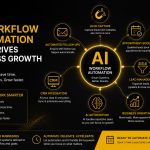
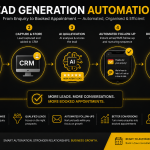
CRM automation allows your business to trigger actions automatically when a lead enters your system. This could include sending a welcome email, sending an SMS confirmation, creating a follow-up task, assigning the lead to a team member, or moving the lead into the correct pipeline stage.
This is powerful because follow-up speed matters. When someone enquires, they are usually actively looking for a solution. If your business responds quickly and professionally, you immediately create a better first impression.
Automation also helps make follow-ups consistent. Instead of relying on staff to remember every step, the CRM can guide the process. It can remind your team when to call, send a message if the lead has not responded, or update the pipeline when an appointment is booked.
Example:
A lead submits a website enquiry. The CRM automatically sends a thank-you SMS, adds the lead to the “New Enquiry” stage, notifies the business owner, and schedules a follow-up task for the next morning. The lead feels acknowledged, and the business does not miss the opportunity.
CRM as a Service: A Smarter Option for Busy Business Owners
Many business owners understand that they need a CRM, but they do not have the time or technical knowledge to set one up properly. This is where CRM as a Service becomes valuable.
CRM as a Service means your CRM system is planned, set up, customised, automated, and supported for you. Instead of buying software and trying to figure everything out yourself, you get a practical system designed around how your business actually works.
This can include pipeline setup, contact organisation, automation workflows, email and SMS templates, appointment booking links, task reminders, reporting dashboards, and ongoing support. The goal is not just to give you software. The goal is to give you a working business system.
Example:
A business owner wants to manage leads from their website, Facebook ads, and phone enquiries. With CRM as a Service, 2in1 Digital can create a lead pipeline, connect forms, automate follow-ups, and set up reminders so the business owner knows exactly what happens after every enquiry.
How CRM and AI Work Together
A CRM helps organise your leads, but AI can make the process even smarter. AI can help summarise enquiries, identify lead intent, generate suggested replies, classify leads, and support faster communication.
For example, AI can help determine whether a lead is asking for pricing, booking availability, service information, or support. This information can help your team prioritise the right leads and respond with the right message.
AI can also support follow-up workflows. Instead of every message being written from scratch, AI-assisted templates can help create faster, more relevant responses. This saves time while still allowing your team to add a personal touch where needed.
Example:
A lead submits a form saying they need help automating their customer follow-ups. AI can help identify the enquiry as an automation-related lead, add a suitable tag in the CRM, and trigger a follow-up sequence focused on AI automation and CRM setup.
How Virtual Assistants Support CRM Management
Even with automation, human support is still important. A CRM can organise information and trigger workflows, but someone still needs to review leads, check details, make calls, update notes, and keep the system clean.
This is where virtual assistant support becomes useful. A trained VA can help manage your CRM daily by checking new leads, updating contact records, booking appointments, sending follow-up messages, preparing reports, and making sure no opportunity is ignored.
When CRM automation and VA support work together, the business gets the best of both worlds. Automation handles repetitive tasks, while a VA provides the human attention needed to keep the system accurate and active.
Example:
The CRM automatically captures new leads and sends initial follow-ups. Each morning, a VA reviews the pipeline, checks which leads need attention, sends personalised messages, and updates the business owner with a daily summary.
Signs Your Business Needs a CRM
You probably need a CRM if you regularly ask yourself where a lead came from, whether someone has followed up, or why a prospect stopped responding. These are signs that your current process is not giving you enough visibility.
You may also need a CRM if your enquiries are coming from multiple sources. Website forms, emails, calls, Facebook messages, Google ads, and referrals can become difficult to manage if there is no central system.
Another sign is that you are relying heavily on manual follow-ups. If your team has to remember every call, message, reminder, and next step manually, there is a high chance something will eventually be missed.
Example:
A business receives enquiries from its website, Facebook page, and referral partners. The owner uses a spreadsheet to track them, but the spreadsheet is not always updated. A CRM would create a more reliable system where every lead has a status, history, and next action.
What a Good CRM System Should Include
A good CRM should be simple enough to use every day but powerful enough to support your business growth. It should not feel like another complicated task. It should make your daily workflow easier.
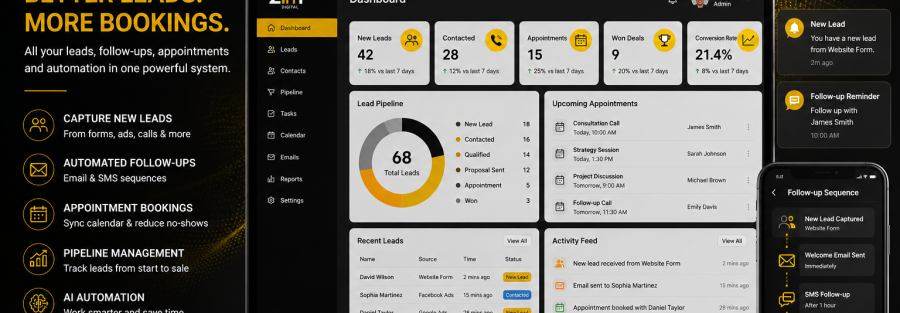
A strong CRM setup should include contact management, lead source tracking, pipeline stages, follow-up reminders, appointment booking, email and SMS automation, notes, reporting, and task assignment. These features help your team understand what is happening and what needs to happen next.
Most importantly, your CRM should be customised to your business. A generic setup may not match your customer journey. The best CRM system is one that reflects how your leads actually move from enquiry to sale.
Example:
A lead pipeline might include stages such as New Lead, Contacted, Qualified, Proposal Sent, Appointment Booked, Won, and Lost. This gives the business a clear view of where every opportunity sits.
Why CRM Automation Helps Businesses Grow
Business growth is not only about attracting more leads. It is also about converting more of the leads you already have. A CRM helps improve conversion by making the sales process more organised, timely, and consistent.
When every lead is tracked, every follow-up is scheduled, and every conversation is recorded, your business becomes more professional. Customers feel like they are being looked after, and your team knows what to do next.
CRM automation also gives you better data. You can see how many leads came in, where they came from, how many converted, how long it took to respond, and which stages need improvement. This makes it easier to improve your marketing and sales process over time.
Example:
If your CRM shows that many leads are stuck at the “Contacted” stage, you may need a stronger follow-up sequence. If many leads are booking appointments but not converting, you may need to improve your consultation process.
How 2in1 Digital Can Help
At 2in1 Digital, we help businesses build practical CRM systems that support daily operations, lead generation, AI automation, and customer follow-ups. We focus on creating systems that are useful, simple, and aligned with how your business works.
Our CRM as a Service solution can help you capture leads, organise enquiries, automate follow-ups, manage appointments, track opportunities, and support your team with clear workflows. We can also combine CRM automation with AI tools and VA support to make your process even smoother.
The aim is to help your business stop missing opportunities and start managing leads with more confidence. Instead of chasing scattered enquiries, you can have one organised system that keeps your team and customers moving in the right direction.
Example:
A business that struggles with missed enquiries can work with 2in1 Digital to build a CRM pipeline, connect website forms, automate SMS and email follow-ups, assign tasks to a VA, and track results through a simple dashboard.
Final Thoughts
A CRM is more than just a database. It is the system that helps your business turn enquiries into conversations, conversations into appointments, and appointments into customers.
If your business is generating leads but struggling to manage them, follow up consistently, or keep everything organised, CRM automation can make a major difference. It helps reduce manual work, improve response times, and create a better experience for both your team and your customers.
When combined with AI automation and VA support, a CRM becomes even more powerful. It gives your business the structure, speed, and support needed to handle leads properly and grow more efficiently.
That is why 2in1 Digital offers CRM as a Service — to help businesses combine smart technology and reliable support into one complete lead management system.
Ready to stop losing leads?
Book a free consultation with 2in1 Digital and discover how CRM automation, AI workflows, and VA support can help your business capture, organise, and convert more enquiries.
FAQs
What is CRM automation?
CRM automation uses technology to manage repetitive lead and customer tasks, such as follow-up reminders, email and SMS messages, pipeline updates, appointment scheduling, and task assignments.
What is CRM as a Service?
CRM as a Service means your CRM system is set up, customised, managed, and supported for your business, so you can use it effectively without handling all the technical work yourself.
Do small businesses need a CRM?
Yes. A CRM helps small businesses track leads, organise customer information, manage follow-ups, and reduce missed opportunities.
Can a CRM help me get more sales?
A CRM can help improve sales by making sure leads are followed up consistently, customer information is organised, and opportunities are tracked properly through the sales process.
Can 2in1 Digital help manage my CRM?
Yes. 2in1 Digital can help with CRM setup, automation workflows, lead pipeline management, AI tools, and VA support to keep your system organised and active.